On the invisible architecture of learning, the philosophy of becoming, and the courage not to know
What if curiosity is the curriculum?

I arrived in Weimar with a familiar collection of questions. After more than two decades of working in education, designing learning experiences, and facilitating processes of discovery, I have become increasingly interested in what remains beyond our carefully constructed methodologies. What actually makes learning happen? How do we create space for uncertainty while resisting our instinct to organise, direct, and explain? And perhaps, more personally, how do we remain learners when we have spent so much of our lives facilitating the learning of others? I was participating in SOFT – The Art of Facilitation, a training course inviting us to reconsider our practices and explore self-directed learning. Somewhere between conversations, observations, and walks through Weimar, I found myself following an unexpected path. It began with fascia. Then fungi. Then Goethe, Schiller, and Faust. And eventually, a growing fascination with something I began calling the art of bewilderment.
The philosophical necessity of not knowing
In How We Think (1910), philosopher and educational reformer John Dewey described reflective thinking as beginning with:
"a state of perplexity, hesitation, doubt"
For Dewey, uncertainty was not simply an obstacle, but a condition from which inquiry could emerge. We have become remarkably skilled at constructing learning objectives, competencies, and measurable outcomes. But where, within these structures, do we make room for bewilderment? For encounters that unsettle our assumptions without immediately replacing them with new certainties?
Psychologist George Loewenstein's information-gap theory suggests that curiosity can arise when we recognise a discrepancy between what we know and what we want to understand. Yet I wonder whether there is another dimension worth cultivating: the capacity to remain with uncertainty rather than immediately attempting to resolve it. Perhaps curiosity is not only a desire to close the gap between knowing and not knowing, but also an invitation to explore what the gap reveals.
The invisible architecture of connection
My curiosity first led me toward fascia, the connective tissues that surround and interact with structures throughout the human body. What fascinated me was the idea of connection as something more complex than attachment. Connection provides support, but can also transmit tension. Boundaries create separation while making coordinated movement possible. I began imagining learning environments as intricate networks of relationships, expectations, histories, identities, and invisible influences. A participant never arrives as an isolated mind waiting to receive knowledge. They arrive with a body, memories, cultural experiences, emotions, assumptions, and possibilities. This brought me toward embodied approaches to cognition, particularly the work of Varela, Thompson, and Rosch, who explored cognition through our bodily capacities and interactions with the world.
And so my question became:
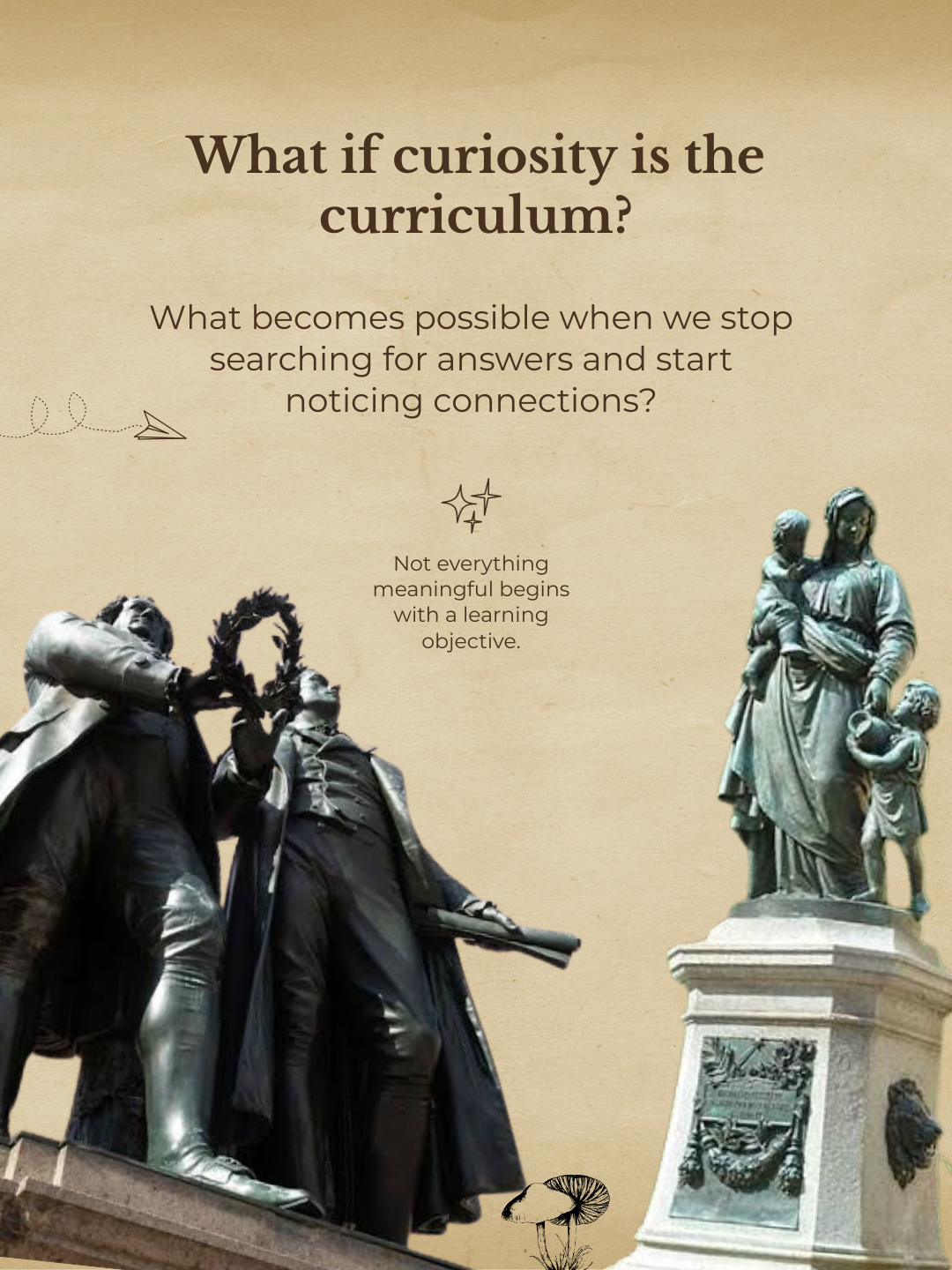
What if facilitation is less about transmitting knowledge and more about cultivating the relationships through which new understandings become possible?
Then my curiosity moved underground.
Fungal mycelium consists of networks of microscopic filaments, sometimes forming relationships with plant roots through which resources are exchanged. It is tempting to imagine these networks as harmonious communities. Yet research by Karst, Jones, and Hoeksema (2023) challenges several popular interpretations of mycorrhizal networks, reminding us that interconnectedness does not necessarily imply cooperation. I find this distinction valuable. Relationships can involve competition, dependency, exchange, and unequal influence. Perhaps the same applies to learning communities. Connection isn't inherently positive. A meaningful learning environment must consider not only how people connect, but how they retain autonomy within those connections. The fungal metaphor also reminded me of something I have encountered repeatedly throughout my years as a facilitator. Sometimes former participants contact me years after a workshop to describe moments that profoundly influenced them. Often these are not the moments I imagined would matter. Their meaning became visible only much later.
How much of learning happens outside our observation? How much continues growing long after the formal learning experience has ended?
Perhaps we need greater humility about our ability to measure our influence.
Goethe, Schiller, and the art of becoming
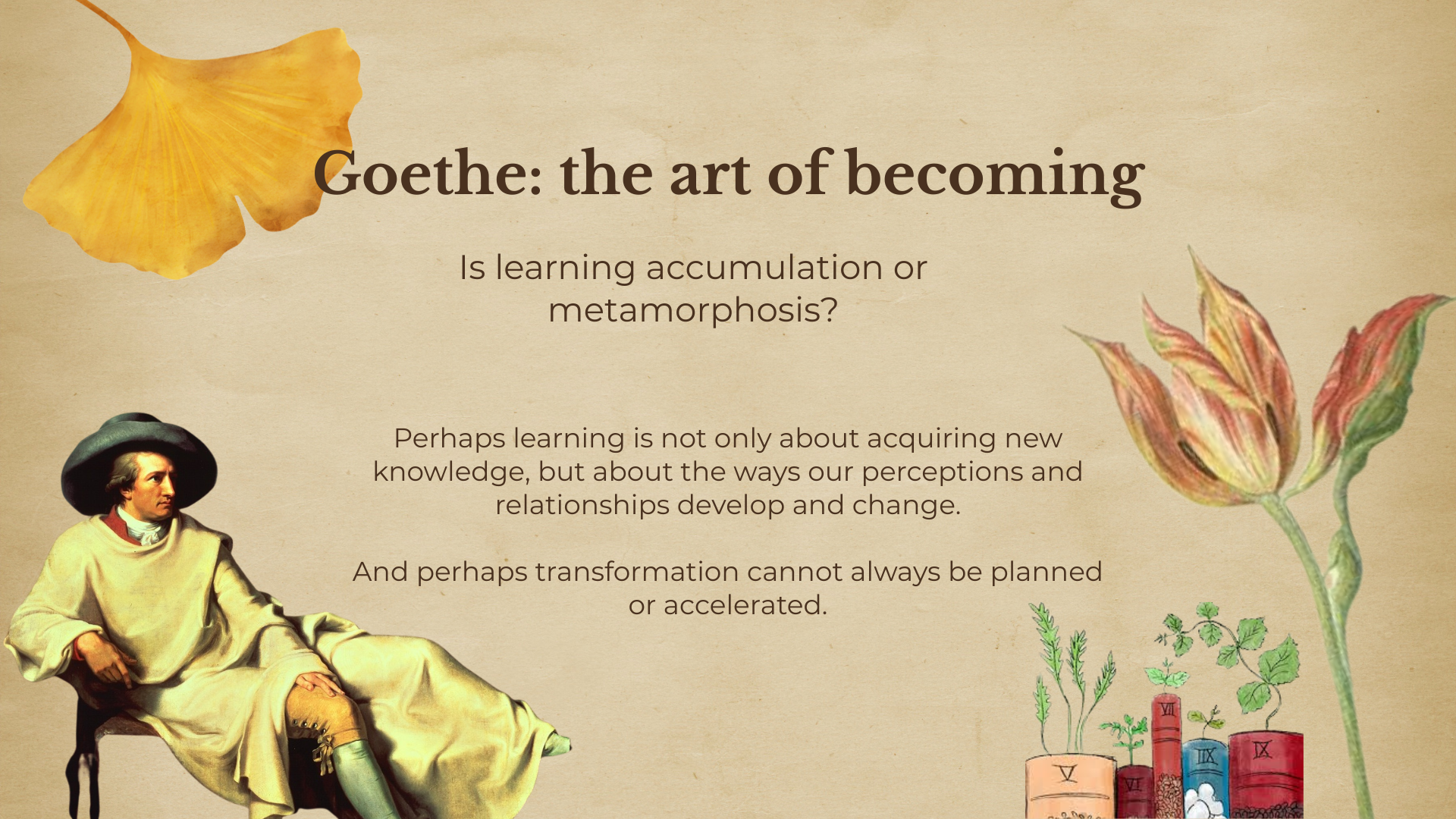
Walking through Weimar inevitably brought me into conversation with Goethe. Beyond his literary legacy, Goethe was an attentive observer of nature. His botanical investigations, culminating in The Metamorphosis of Plants (1790), explored relationships between plant forms and their transformation. This offered me another philosophical connection. What if learning is not merely accumulation, but metamorphosis? Adult learning theorist Jack Mezirow suggested that transformative learning involves critically examining the assumptions through which we interpret experience. We can acquire enormous amounts of information without fundamentally reconsidering our relationship with ourselves or the world. Conversely, an ordinary encounter can alter something we thought we understood. Perhaps transformation is less an event than a process of becoming. But if learning involves transformation, must transformation always be our objective?
Or does our desire to produce change sometimes interfere with the conditions in which change might emerge?
Schiller's Letters on the Aesthetic Education of Man (1795) introduced another dimension: the relationship between sensory experience, rational capacities, and the freedom found through play. In his fifteenth letter, he famously writes:
"he is only fully a human being when he plays"
For Schiller, play extends beyond recreation, offering a possibility of freedom from being entirely governed by either sensation or rational demands. I began considering what this means for facilitation. How much structure do we need to become free? Too much structure can suppress experimentation. Too little can leave participants unsupported. Perhaps softness is not the absence of structure, but a different relationship with it. One that remains responsive rather than rigid. This tension was particularly alive for me during SOFT. I value self-directed learning deeply, yet autonomy does not eliminate our need for guidance, care, or thoughtful facilitation. Freedom without care can become abandonment. Structure without freedom can become control. The art may lie somewhere in the relationship between them.
Faust and the exhaustion of endless striving
And then there was Faust. Goethe's restless scholar, dissatisfied with the limits of his knowledge, offered an uncomfortable mirror to our contemporary relationship with self-development. We live in a culture that constantly encourages us to become more. More knowledgeable, productive, resilient, emotionally intelligent, adaptable. Even our vulnerability and rest can become opportunities for improvement. And learning, something I have always loved, can quietly become another demand placed upon ourselves. I began wondering about the language we use in education. We speak endlessly about growth, development, transformation, and potential. But what happens when we stop trying so hard to become something? Can we experience learning without turning every encounter into an opportunity for self-optimisation? Can we allow ourselves to remain unfinished? Perhaps there is a particular freedom in not treating our present selves as permanent projects awaiting improvement.
Learning as an ecology of encounters
Looking back, I realised that the most interesting part of my Open Path was not any individual discovery, but the unexpected relationships between them. Fascia made me think about connection and movement. Mycelium complicated my assumptions about interconnectedness. Goethe invited me to reconsider transformation. Schiller brought me toward form and freedom. Faust confronted me with endless striving. And Weimar itself became more than the location of a training course. Its streets, history, art, and intellectual legacy became part of the inquiry. None of these encounters belonged to a single curriculum. Yet together, they created a learning experience.
Perhaps learning is not a straight line, but an ecology of encounters, tensions, memories, questions, and possibilities. An ecology, however, is not automatically harmonious. Its relationships can be fragile, unequal, and contradictory. For me, this makes facilitation an ethical practice as much as a pedagogical one. We cannot determine precisely what another person will learn. But we can attend to the conditions in which learning becomes possible. We can consider whose voices are heard, whose experiences are recognised, and how power circulates through learning environments. And perhaps, sometimes, we can resist the impulse to intervene - because meaning cannot always be created on someone else's behalf.
The art of bewilderment
Eventually, I gathered these explorations into a presentation for the other participants at SOFT. I called it The Art of Bewilderment. There was something wonderfully contradictory about trying to organise an experience that had taught me the value of not always knowing where I was going. I was giving form to something that had emerged through wandering. Perhaps that is precisely the tension I want to keep exploring. We need frameworks to understand learning, but frameworks cannot fully capture its complexity. We need structure to create meaningful experiences, but too much certainty can prevent us from recognising what lies beyond our expectations. I have come to appreciate bewilderment not as confusion or ignorance, but as a form of openness. A willingness to encounter something without immediately claiming to understand it. A capacity to remain curious in the presence of complexity. A recognition that some questions become more valuable the longer we live with them. After more than twenty years in education and facilitation, I still find myself discovering how much I do not know. And increasingly, I regard that not as a limitation, but as an invitation. I left this Open Path without a new methodology. Instead, I found myself returning to a question that I suspect will accompany me for a while:
What becomes possible when we stop searching for answers and start noticing connections?
And perhaps, just as importantly: Can we learn to trust the unfinished?
References and further reading
Philosophy and educational theory
Dewey, J. (1910). How We Think. D. C. Heath & Co. Full text.
Goethe, J. W. von. (1790). Versuch die Metamorphose der Pflanzen zu erklären. Original edition.
Schiller, F. (1795). Über die ästhetische Erziehung des Menschen in einer Reihe von Briefen. Philosophical commentary.
Goethe, J. W. von. (1808, 1832). Faust, Parts I and II.
Academic research
Bordoni, B., et al. (2022). Fascial Nomenclature: Update 2022. Full text.
Karst, J., Jones, M. D., & Hoeksema, J. D. (2023). Positive citation bias and overinterpreted results lead to misinformation on common mycorrhizal networks in forests. Nature Ecology & Evolution, 7, 501–511. DOI.
Loewenstein, G. (1994). The psychology of curiosity: A review and reinterpretation. Psychological Bulletin, 116(1), 75–98. DOI.
Mezirow, J. (1997). Transformative learning: Theory to practice. New Directions for Adult and Continuing Education, 1997(74), 5–12. DOI.
Varela, F. J., Thompson, E., & Rosch, E. (1991). The Embodied Mind: Cognitive Science and Human Experience. MIT Press.
The biological concepts in this essay are used as philosophical metaphors, rather than scientific explanations of human learning.